Test JN0-683 Questions Fee & Latest JN0-683 Exam Testking
Wiki Article
DOWNLOAD the newest BraindumpQuiz JN0-683 PDF dumps from Cloud Storage for free: https://drive.google.com/open?id=1HQ_CFN_n0-CTtLGOHcqJVb2GhrlBmCRy
As is known to us, a good product is not only reflected in the strict management system, complete quality guarantee system but also the fine pre-sale and after-sale service system. In order to provide the best JN0-683 test training guide for all people, our company already established the integrate quality manage system, before sell serve and promise after sale. If you buy the JN0-683 Exam Dumps from our company, we can make sure that you will have the right to enjoy the 24 hours full-time online service. In order to help the customers solve the problem at any moment, our server staff will be online all the time.
We are equipped with excellent materials covering most of knowledge points of JN0-683 pdf torrent. Our learning materials in PDF format are designed with JN0-683 actual test and the current exam information. Questions and answers are available to download immediately after you purchased our JN0-683 Dumps PDF. The free demo of pdf version can be downloaded in our exam page.
>> Test JN0-683 Questions Fee <<
2026 Test JN0-683 Questions Fee | Valid Data Center, Professional (JNCIP-DC) 100% Free Latest Exam Testking
If you failed to do so then the customer gets a full refund from BraindumpQuiz according to the terms and conditions. Users can start using Juniper JN0-683 instantly after purchasing it. Three JN0-683 Exam Questions format is provided to customers so that they can access the Data Center, Professional (JNCIP-DC) (JN0-683) prep material in every possible way according to their needs.
Juniper JN0-683 Exam Syllabus Topics:
| Topic | Details |
|---|---|
| Topic 1 |
|
| Topic 2 |
|
| Topic 3 |
|
| Topic 4 |
|
| Topic 5 |
|
Juniper Data Center, Professional (JNCIP-DC) Sample Questions (Q18-Q23):
NEW QUESTION # 18
Which three statements are correct about symmetric IRB routing with EVPN Type 2 routes? (Choose three.)
- A. Symmetric routing requires an extra transit VNI for each VRF.
- B. Symmetric routing is less efficient than asymmetric routing.
- C. Symmetric routing supports the EVPN service VLAN bundle.
- D. Symmetric routing requires MAC-VRF.
- E. An L3 interface (IRB) is required for each local VLAN.
Answer: A,D,E
Explanation:
* Symmetric IRB Routing with EVPN Type 2 Routes:
* Symmetric Routing: In symmetric IRB (Integrated Routing and Bridging), routing occurs in both directions at the ingress and egress leaf nodes using the same routing logic. This is contrasted with asymmetric routing, where different routing logic is used depending on the direction of the traffic.
* Required Components:
* Option A:An L3 IRB interface is necessary for each VLAN that participates in routing, as it handles the Layer 3 processing for the VLAN.
* Option B:MAC-VRF is required for symmetric routing to maintain a mapping of MAC addresses to the appropriate VRF, ensuring correct forwarding within the EVPN.
* Option D:A transit VNI (Virtual Network Identifier) is required for each VRF to encapsulate the Layer 3 traffic as it traverses the network, allowing the IP traffic to be appropriately forwarded.
Conclusion:
* Option A:Correct-Each local VLAN needs an IRB interface for L3 processing.
* Option B:Correct-MAC-VRF is necessary for handling MAC address resolution in symmetric routing.
* Option D:Correct-Transit VNIs are required for routing VRF-specific traffic across the network.
OptionsCandEare incorrect because:
* C:Symmetric routing can work with various VLAN models, including single or multiple VLANs within an EVPN instance.
* E:Symmetric routing is generally more efficient than asymmetric routing as it uses consistent routing logic in both directions.
NEW QUESTION # 19
You want to convert an MX Series router from a VXLAN Layer 2 gateway to a VXLAN Layer 3 gateway for VNI 100. You have already configured an IRB interface. In this scenario, which command would you use to accomplish this task?
- A. set protocols ospf area 0.0.0.0 interface irb.100 passive
- B. set protocols isis interface irb.100 passive
- C. set bridge-domains VLAN-100 routing-interface irb.100
- D. set vlans VLAN-100 13-interface irb.100
Answer: C
Explanation:
* Scenario Overview:
* Converting an MX Series router from a VXLAN Layer 2 gateway to a VXLAN Layer 3 gateway involves transitioning the router's functionality from simply bridging traffic within a VXLAN segment to routing traffic between different segments.
* Key Configuration Requirement:
* IRB (Integrated Routing and Bridging) Interface:An IRB interface allows for both Layer 2 switching and Layer 3 routing. To enable routing for a specific VNI (VXLAN Network Identifier), the IRB interface must be associated with the routing function in the corresponding bridge domain.
* Correct Command:
* C. set bridge-domains VLAN-100 routing-interface irb.100:This command correctly binds the IRB interface to the bridge domain, enabling Layer 3 routing functionality within the VXLAN for VNI 100. This effectively transitions the device from operating solely as a Layer 2 gateway to a Layer 3 gateway.
Data Center References:
* This configuration step is essential when converting a Layer 2 VXLAN gateway to a Layer 3 gateway, enabling the MX Series router to route between VXLAN segments.
NEW QUESTION # 20
You are implementing seamless stitching between two data centers and have a proposedconfiguration for a border leafdevice.
In this scenario, which two statements are correct? {Choose two.)
- A. The translation-vni must match in both data centers.
- B. The ESI must be different in each data center.
- C. The ESI must match in both data centers.
- D. The translation-vni must be different in each data center.
Answer: C,D
Explanation:
* Understanding Seamless Stitching:
* Seamless stitching is used in EVPN to interconnect two data centers, allowing for consistent Layer 2 and Layer 3 connectivity across them. This is often achieved by translating VNIs (Virtual Network Identifiers) between the data centers.
* Translation-VNI:
* Option B:The translation VNI must be different in each data center to ensure that traffic can be correctly routed and distinguished as it crosses between the data centers. This differentiation helps to maintain the integrity of the traffic flows and prevents any potential overlap or conflict in VNIs.
* Ethernet Segment Identifier (ESI):
* Option D:The ESI must match in both data centers to ensure that the same Ethernet segment (which could be multihomed) is recognized consistently across the data centers. Matching ESIs are crucial for maintaining a unified view of the Ethernet segment across the interconnected fabric.
Conclusion:
* Option B:Correct-Translation VNIs must be unique to each data center for proper traffic distinction.
* Option D:Correct-Matching ESIs are necessary to maintain consistent Ethernet segment identification across both data centers.
NEW QUESTION # 21
Referring to the exhibit, Host1 (10.1.1.1) if failing to communicate with Host2 (10.1.2.1) in a data center that uses an ERB architecture.
What do you determine from the output?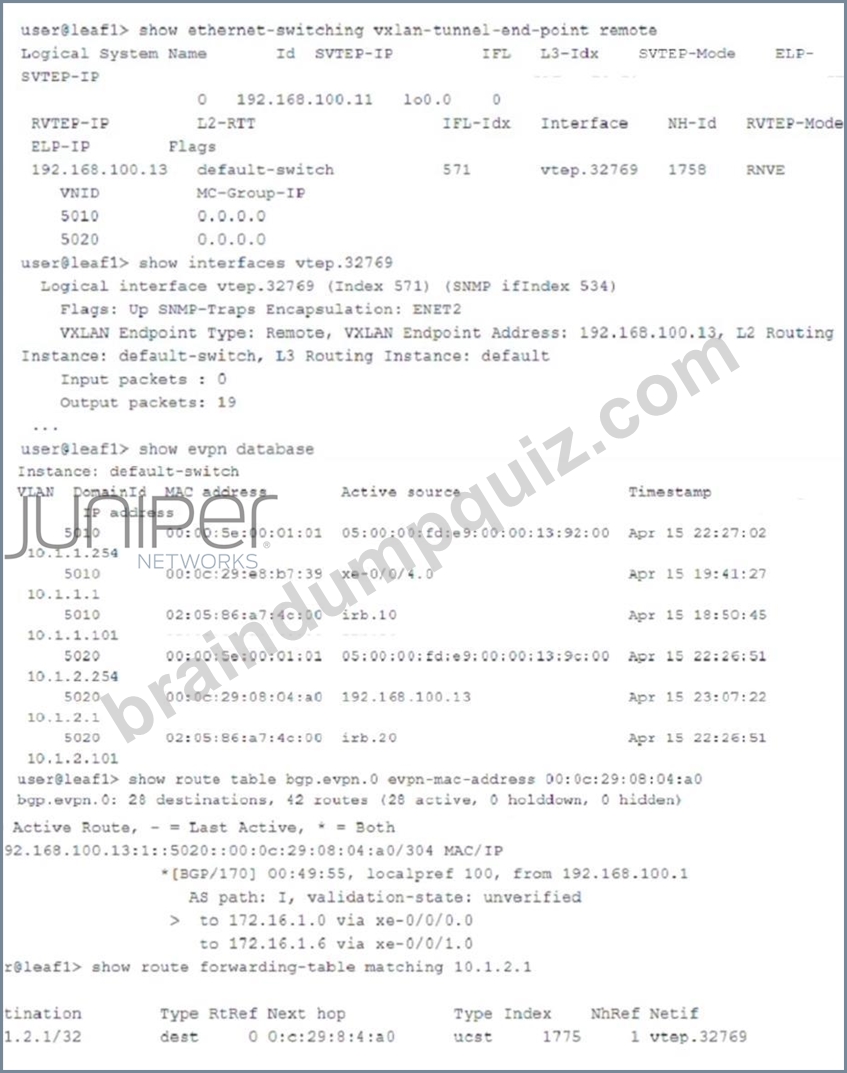
- A. The traffic is failing because load balancing is not configured correctly.
- B. Host1 and Host2 are directly connected to leaf1.
- C. The traffic is entering the VXLAN tunnel.
- D. The irb.20 interface is not configured on leaf1.
Answer: C
Explanation:
The traffic is entering the VXLAN tunnel: This is the most likely cause of the issue, as indicated by the presence of VXLAN (Virtual Extensible LAN) configurations and EVPN (Ethernet VPN) MAC address tables in the exhibit. The communication between Host1 and Host2 may not be properly routed through the VXLAN tunnel, causing the failure.
NEW QUESTION # 22
Exhibit.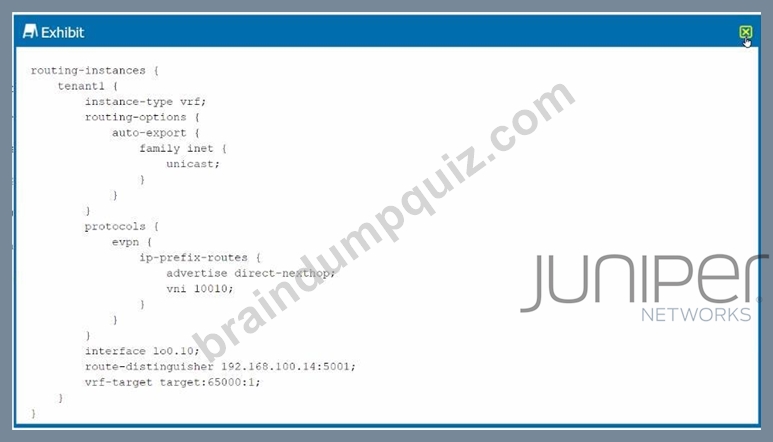
You want to enable the border leaf device to send Type 5 routes of local networks to the border leaf device in another data center. What must be changed to the configuration shown in the exhibit to satisfy this requirement?
- A. Add encapsulation vxlan to the evpn hierarchy.
- B. Add a VLAN configuration with an 13-interface to the tenant1 routing instance.
- C. Move vrf-target target: 65000:1 to the evpn hierarchy.
- D. Change: 5001 in the route-distinguisher to : 10010.
Answer: C
Explanation:
In this scenario, you want the border leaf device to advertise Type 5 EVPN routes to another border leaf in a different data center. Type 5 routes in EVPN are used to advertise IP prefixes, which means that for proper route advertisement, you need to configure the correct settings within the evpn hierarchy.
Step-by-Step Analysis:
* Understanding EVPN Type 5 Routes:
* EVPN Type 5 routes are used to advertise IP prefixes across EVPN instances, which allow different data centers or networks to exchange routing information effectively.
* VRF Target Setting:
* The vrf-target configuration is crucial because it defines the export and import policies for the VRF within the EVPN instance. For EVPN Type 5 routes to be advertised to other border leaf devices, the vrf-target needs to be correctly configured under the evpn hierarchy, not just within the routing instance.
Command to solve this:
move vrf-target target:65000:1 to evpn
* Other Options:
* Option B:Adding a VLAN configuration would not address the requirement to advertise Type 5 routes.
* Option C:Adding VXLAN encapsulation may be necessary for other scenarios but does not directly address the Type 5 route advertisement.
* Option D:Changing the route-distinguisher will differentiate routes but does not impact the advertisement of Type 5 routes to other data centers.
By moving the vrf-target to the evpn hierarchy, you enable the proper route advertisement, ensuring that the Type 5 routes for local networks are shared with other data center border leaf devices. This is aligned with best practices for multi-data center EVPN implementations, which emphasize the correct placement of routing policies within the EVPN configuration.
NEW QUESTION # 23
......
In this age of the Internet, do you worry about receiving harassment of spam messages after you purchase a product, or discover that your product purchases or personal information are illegally used by other businesses? Please do not worry; we will always put the interests of customers in the first place, so JN0-683 study materials ensure that your information will not be leaked to any third party. After you pass the exam, if you want to cancel your account, contact us by email and we will delete all your relevant information. Second, the purchase process of JN0-683 Study Materials is very safe and transactions are conducted through the most reliable guarantee platform. Last but not least, our website platform has no viruses and you can download JN0-683 study materials at ease. If you encounter difficulties in installation or use of JN0-683 study materials, we will provide you with remote assistance from a dedicated expert.
Latest JN0-683 Exam Testking: https://www.braindumpquiz.com/JN0-683-exam-material.html
- JN0-683 Vce Download ⛪ JN0-683 Exam Paper Pdf ???? JN0-683 Exam Vce ???? Search for ▷ JN0-683 ◁ and download it for free immediately on “ www.examcollectionpass.com ” ????JN0-683 Authentic Exam Hub
- Reliable JN0-683 Dumps Ebook ???? Exam JN0-683 Forum ???? Exam JN0-683 Bootcamp ???? Search for “ JN0-683 ” and easily obtain a free download on ➥ www.pdfvce.com ???? ????Reliable JN0-683 Dumps Ebook
- JN0-683 test braindump, Juniper JN0-683 test exam, JN0-683 real braindump ???? Immediately open 「 www.pdfdumps.com 」 and search for ⇛ JN0-683 ⇚ to obtain a free download ????JN0-683 Braindumps
- Reliable Exam JN0-683 Pass4sure ???? JN0-683 Latest Study Plan ???? JN0-683 Formal Test ???? Download 「 JN0-683 」 for free by simply searching on “ www.pdfvce.com ” ????Braindumps JN0-683 Pdf
- JN0-683 Latest Study Plan ???? JN0-683 Formal Test ???? JN0-683 Latest Study Plan ???? Go to website ✔ www.verifieddumps.com ️✔️ open and search for ➠ JN0-683 ???? to download for free ????JN0-683 Dump
- Reliable JN0-683 Exam Topics ???? JN0-683 Test Simulator Fee ???? Latest JN0-683 Exam Answers ???? Download ▷ JN0-683 ◁ for free by simply searching on { www.pdfvce.com } ????JN0-683 Vce Download
- Latest JN0-683 Exam Answers ???? JN0-683 Braindumps ☝ Latest JN0-683 Test Notes ???? Search for ⇛ JN0-683 ⇚ and obtain a free download on 「 www.practicevce.com 」 ????JN0-683 Dump
- Efficient Test JN0-683 Questions Fee - Easy and Guaranteed JN0-683 Exam Success ???? Download ➡ JN0-683 ️⬅️ for free by simply searching on ➥ www.pdfvce.com ???? ✒Exam JN0-683 Bootcamp
- Test JN0-683 Questions Fee - Free PDF Quiz 2026 Juniper First-grade Latest JN0-683 Exam Testking ???? Simply search for ( JN0-683 ) for free download on ☀ www.practicevce.com ️☀️ ????Reliable Exam JN0-683 Pass4sure
- Latest JN0-683 Test Notes ❔ JN0-683 Latest Study Plan ???? Valid Braindumps JN0-683 Questions ???? The page for free download of ▶ JN0-683 ◀ on ✔ www.pdfvce.com ️✔️ will open immediately ????Dumps JN0-683 Free Download
- Latest JN0-683 Exam Answers ???? Reliable JN0-683 Dumps Ebook ???? Latest JN0-683 Exam Answers ???? Search for ✔ JN0-683 ️✔️ and download it for free on ▷ www.easy4engine.com ◁ website ????JN0-683 Vce Download
- denishwdg339896.bcbloggers.com, barbarapzcq754770.bleepblogs.com, cruxbookmarks.com, ihannaddue614823.wikiparticularization.com, lawsonokqt813130.bloguerosa.com, emilylmsh049941.iamthewiki.com, alvinywsc409249.azzablog.com, anitagefk290892.lotrlegendswiki.com, classifylist.com, larissatuoh499144.mappywiki.com, Disposable vapes
DOWNLOAD the newest BraindumpQuiz JN0-683 PDF dumps from Cloud Storage for free: https://drive.google.com/open?id=1HQ_CFN_n0-CTtLGOHcqJVb2GhrlBmCRy
Report this wiki page